AI Strategy Guide: the augmented organization.
How to move from rigid hierarchies to high-performing, hybrid teams of human experts and digital agents.
30 minutes, online, free and non-binding.
An augmented organization doesn't deploy AI as a cost-cutting measure, but as a growth engine: AI agents do the cognitive groundwork, and humans orchestrate and approve. It rests on three pillars, cognitive relief, process integrity, and asynchronous scaling, and begins with a new narrative inside the company.
From hierarchies to hybrid teams
Integrating artificial intelligence into SMEs isn't purely an IT project. It's a fundamental restructuring of the value chain: away from rigid hierarchies, toward hybrid teams of human experts and digital agents.
This guide serves as a navigation system. It connects the need for augmentation with the reality of operational implementation, as the link between strategy and an ordinary "Monday morning."
Step 1: understand the foundation
Before you change processes, you have to change the narrative inside the company. Many companies fail at rollout because they sell AI as a cost-cutting measure instead of treating it as a growth engine.
Why trying to replace people with AI leads you astray is something we examine in the deep dive "The Substitution Lie." Central to this is the Jevons paradox: as work becomes more efficient, demand for it grows. AI doesn't replace your experts, it promotes them.
The three pillars of augmentation
1. Cognitive relief
We don't delegate responsibility, we delegate the groundwork. AI takes on research, data synthesis, and first drafts. Humans no longer start from a blank page.
2. Process integrity
Automations need to run stably and reliably. An agent that hallucinates is a risk. That's why we build legal and domain guardrails firmly into every workflow.
3. Asynchronous scaling
While your team is off for the day, AI agents prepare the next one. Augmentation also means decoupling linear working hours from work output.
Traditional versus augmented organizations
Traditional: employees are paid for executing tasks. Efficiency gains usually just mean "type faster." Innovation happens in isolated silos.
Augmented: employees are paid for orchestrating and controlling outcomes. In the "centaur workflow," humans direct digital agents instead of doing the execution themselves. Efficiency gains come from better prompts and optimized agent workflows.
Operational implementation: the action plan
A transformation usually fails at the bridge between concept and daily work. Our checklist walks step by step through this transformation, from your team's psychological safety to the technical API integration. Three questions come first:
- Validate human-in-the-loop processes: where does compliance, or plain common sense, require a final human sign-off?
- Review data sovereignty: which data may leave your own data center, and for which does a strict on-premise setup apply?
- Identify centaur potential: where does combining human intuition with machine pattern recognition create the biggest advantage?
What should change
- Time to market: fewer manual iterations, AI iterations with human approval.
- Careless errors: the AI checks syntax, the human checks logic.
- Employee retention: less routine load, more focus on challenging work.
Through the asynchronous groundwork of digital agents, humans focus on the final, strategic decision. The last sign-off stays with the domain expert.
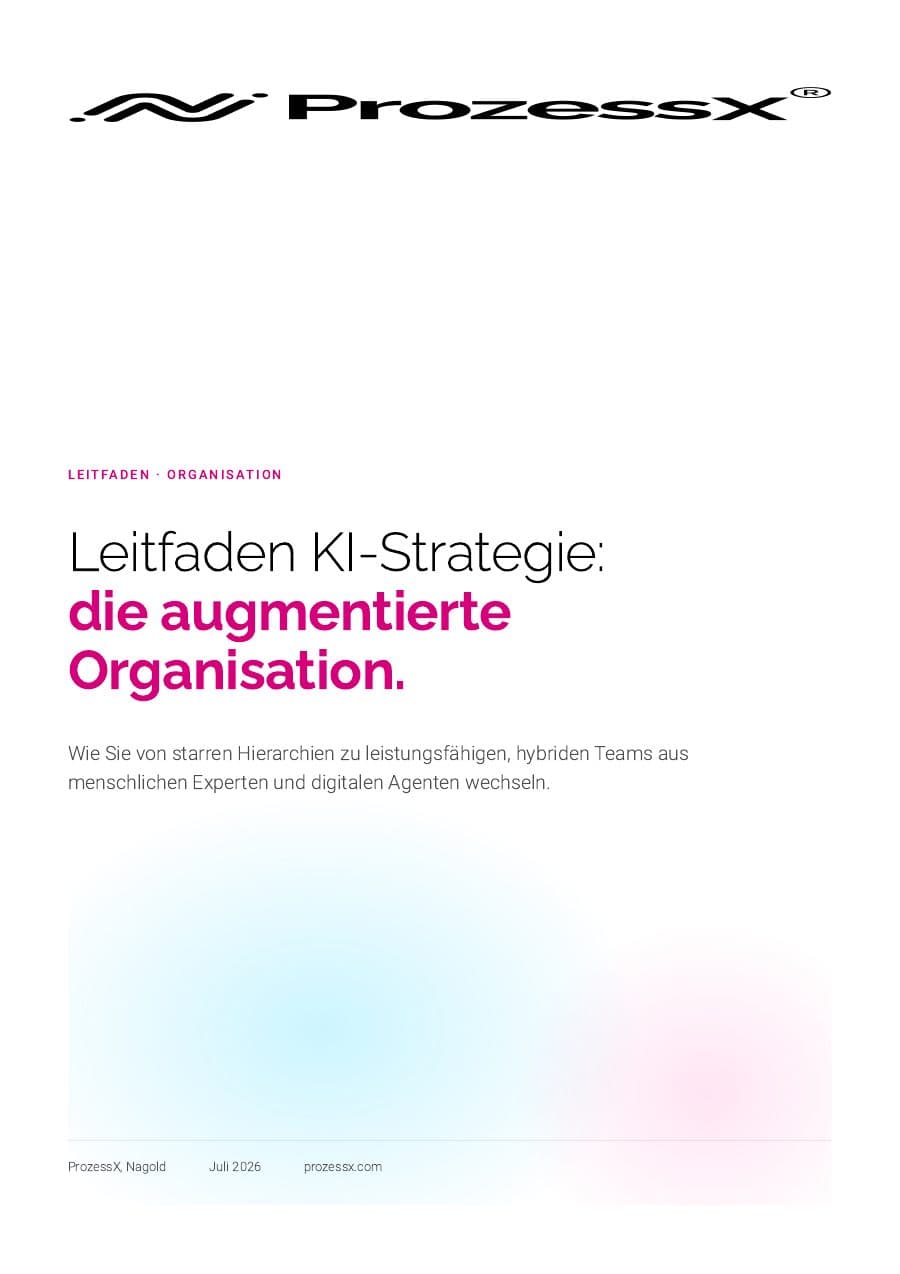
Download as PDF.
Leitfaden as a PDF, 4 pages. Enter your details below to start the download right here.
Before you reach out
What does "augmented organization" actually mean?
An augmented organization no longer relies solely on human labor for execution. It orchestrates hybrid workflows in which AI agents handle the recurring cognitive groundwork and humans give strategic approval.
Does this structure replace my current employees?
No. AI replaces tasks, not jobs. Through the Jevons paradox, efficiency gains mean your employees can take on more complex, higher-value work.
How do we stop errors from AI agents slipping through?
Through process integrity: fixed guardrails in prompts and API structures that stop a drifting agent. The final sign-off always stays with the domain expert.
Can we implement this change within our existing IT infrastructure?
Yes. The change is mostly methodological. The technical integration runs through standardized interfaces into your systems, such as ERP or CRM, with isolated architectures for data sovereignty.
From the guide to application.
Let's clarify what augmentation could look like in your company. We'll get back to you within 24 hours with a proposal for the initial consultation.